Saturday, 7 February 2015

Friday 6th - Panjim

We sleep well and enjoy a very civilised breakfast on the roof terrace. Today's plan is to explore Panjim a little bit and suss out a few things to do over the next few days. We dawdle through the shopping area, buying a pair of shorts for D. There are quite a few Russian tourists about and a surprising number of sales assistants who can speak their lingo. Our wanderings take us down to the esplanade overlooking the River Mandovi and we decide that it is time for a cup of tea. The Quarterdeck Bar and Restaurant is ideally situated with tables by the river and they serve a decent pot of tea. The loos are clean and the open kitchen looks pretty spotless too. We are prepared to forgive the reggae versions of Country and Western standards.

R has awarded Panjim her prestigious Pothole-free Pavements Award but this has to be set against the solid barriers of parked scooters and motobikes that make it difficult to leave the footpath when you want to cross the road. The traffic flows freely at quite high speeds and at times in endless flows, making crossing the busier roads difficult. We want to check out the boat jetty but have difficulty getting there. When we do we discover that the price quoted for an evening cruise in LP is severely out of date. 

R wants to visit the Church of the Immaculate Conception so we stroll through the backstreets with their gently decaying non- Indian architecture and then climb the steps. At the top we discover a service in progress and no admittance for rubber neckers. Time for a beer and then a siesta. We head for the rather upmarket Panjim Inn, recommended by V, a rich Indian friend. As we idle we watch huge plates of food heading up to the restaurant on the balcony. How can people eat so much in the heat. Actually it doesn't feel quite as hot here as it did in Mysore or Hampi.

Around 4 p.m. we head out again with the church as our first target. This time we are admitted but it's a no photo zone. Next up is a visit to the small but well maintained Municipal Gardens which include a pillar that used to be topped by  statue of Vasco da Gama. After the Indians took over Goa this was removed and replaced with the Indian national emblem. He did get to keep his railway station. By now it is getting close to the cocktail hour. At the Quarterdeck D noticed that their snack menu includes Bhel Puri so that is where we head. The bowl of puffed rice and sundry spicy stuff was superb. It probably tastes even better served in a newspaper cone on a train. The beers were not bad either.
Janette,  owner of our Guest House had suggested a trip across the Mandovi on the Betim ferry to visit an old fort. This idea had particular appeal for D when it was mentioned that the ferry ride is free. It turned out to be such good fun that we stayed on for two consecutive return trips. On one of them R got a glimpse of a dolphin but the real fun was watching the crowd of pedestrian and 2 wheeler passengers manoeuvring on and off at either end of the trip. 


We decided that we had better get off before the constabulary were summoned and took a walk along the esplanade as the sun began to sink. A lucky guess takes us to the Municipal Market, a large indoor hall with stalls in a couple of adjacent streets. This is another real market selling useful things to the locals rather than tourist tat. We find a young man sitting on a pile of coconuts wielding a curved machete. For 30 rupees he lops the top off, gives you a straw for the milk and when that is finished he splits it open and extracts the flesh. This is moist and delicious, not at all desiccated like the ones at home. D asks the chap how many fingers he has. He laughs and holds up a full set.
For supper our choice is the Ritz Classic, recommended by P and a few others on the IndiaMike forum. Approached down an alley,  it doesn't look very promising until you get up to the first floor where a very smart doorman greets you. Goa is famous for seafood and we opt for garlic butter prawns, spicy squid and vegetable pulao with a butter naan chaser. Another splendid meal.

Friday, 6 February 2015

Thursday 5th - Goan Slowly

The auto arrives on time and one of the Gopi management team even gets up to check that we get away alright. The drive through the darkness to Hospet station is mainly uneventful apart from the odd unlit bullock cart that wants to cut corners on the wrong side of the road. It is chilly enough to require fleeces. At the station there is a throng gathering,even at this early hour, mainly waiting to catch the train down to Goa. We are travelling Sleeper Class for the journey of around seven and a half hours, our first long trip in this more basic accommodation.

Train 18047 has travelled for around 36 hours since leaving Kolkata so it is no great surprise when it pulls in 30 minutes late. We are in Coach S5, seats 63 and 64. This is a pair of side berths, quite close to the door, so they should be quite easy to find. Most of the shutters are down and it is pretty dark inside the coach. Not so dark that we don't see the four people snuggled into our seats, which have been folded down to make a sleeping berth. There is also a man occupying the upper berth, part of our territory which we intend to use for storing our luggage.

The two (very) large ladies and two small boys on the lower level bestir themslves, allowing D to restore the seat backs and the two of us to get out of the way of the crowd behind who have seats further up the coach. The man upstairs folds himself up to make space for our bags. By now we are underway. The evicted bodies find perches elsewhere in the coach which is clearly carrying more people than the 72 who hold tickets. The six person bay opposite us contains 10 people. The TTE appears but apart from one lady who hands over some cash no action occurs. She does not get a receipt which seems highly irregular to D.

About two hours into the trip we stop at Hubli which has a very smart new station. Our coach stops opposite a catering stand so we have samosas for breakfast and buy a small bunch of bananas for later. We notice that most of the people around us on the train are eating curd out of clay pots. It looks good but we can't spot the source and don't want to risk the train setting off while searching. As it happens there was bags of time. We leave Hubli well over an hour late. All turns out well as the next vendor along the train was selling said clay pots so we had one to share. 'Twas delicious.  The parade of vendors was unceasing - water, sodas, toothbrushes and paste, various breakfast items, peeled cucumbers, peanuts in shells, key rings and most tempting of all - bhel puri. R is convinced that the consumption of this will lead to instant death but it does smell good.


This is our first trip to India that has not included Kolkata. Never mind.  This time Kolkata has come to us. Nearly everybody in the coach seems to be a Bengali heading to Goa for a holiday, mainly in extended family groups. There is a constant game of musical chairs as people move from bay to bay to chat. One teenage girl comes to practice her excellent English with us. She is travelling with her parents, young brother, two aunts plus a husband and a couple of other families. She is concerned about the poor condition of the coach. We were pleasantly surprised by how good it was given that the service had already done two overnights when we boarded. We have seen loos in worse condition in AC on much shorter trips.

R has now christened the man in our upper berth Andy Capp. He never lifts a finger and the rest of his party (about nine in all) attend to his every whim, fetching food, drinks and paan ingredients for him. We spend a lot of time static at wayside stations waiting to cross eastbound trains. Almost everybody except R gets down to stand on the track at these stops. Nobody seems concerned about the increasing delay.


We are now at least two hours late. Eventually we start to wind our way through the Western Ghats, the scenic section of the ride. There is a series of short tunnels which provoke screams from the holidaymakers. The train travels suitably slowly as it passes below the Dudhsagar Falls. There isn't a lot of water flowing at this time of year but it must be spectacular in and just after the monsoon. As it is, the view compensates for the hours we have spent on the sunny side of the train. Too late those on the shady side realise that they are missing out.


We dawdle down the gradients towards Goa. Andy Capp descends to lower berth level to thank us for letting him doss on our pitch. Or maybe he was thanking us for making his wife, kids and sister in law move somewhere else. Hard to tell. During this conversation he did produce his ticket which listed six people with a boarding status of around Wait List 120. These were counter tickets rather than online tickets and seem to allow the holders to travel even if there is no reserved space on the train. D decides that he will never really understand Indian Railways booking system.

As we enter Goa one of the vendors asks D if he would like a beer. This seems like the first step on a slippery slope and is declined.  The said vendor does not reappear so perhaps this was a scam anyway. About 10 miles short of our destination the train stops again to allow several eastbound trains to pass. At the next stop Andy Capp and family get off. He carries his sponge bag while the women carry enomormous suitcases. We finally pull in to Madgaon station three and a half hours late. D has done his research and we get to the prepaid taxi queue before the herd. We are soon on the road for the 50 minute drive to the Afonso Guest House in Panjim, the old Portuguese colonial capital.

We are met by Clifton, the owner's son, and shown to our charming room. After today's experience even D, notoriously tight with a shilling, opted to shell out the extra for AC. A quick shower then out for a beer and pakoras. We are too exhausted to eat any more.

Wednesday 4th - We meet a Heffalump

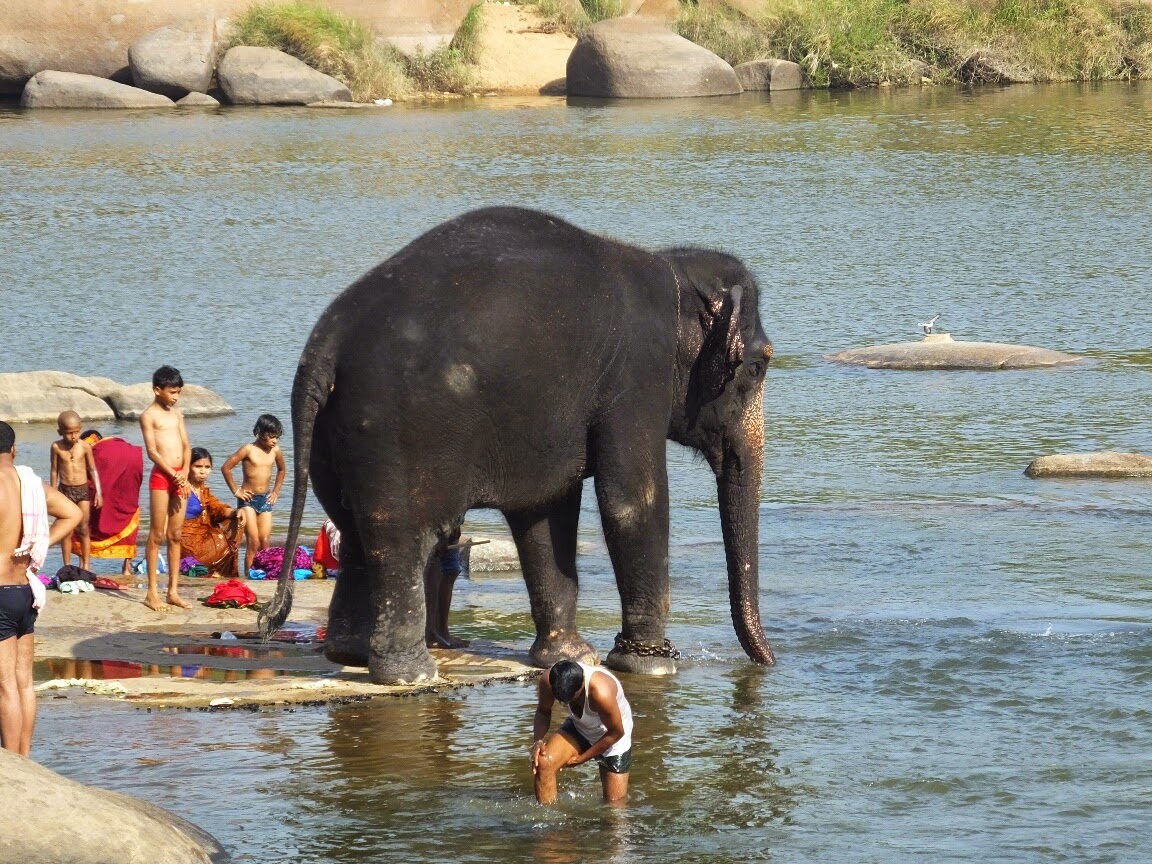
R goes for more yoga fun this morning.  D takes a picture to prove it and goes back to bed. Another leisurely breakfast (the Gopi doesn't seem to do any other sort) and then we head off down to the river to see if there are any birds. What we find is a large crowd of people and an elephant. The book says that the temple elephant, which they say is called Lakshmi, goes for a bath in the river around 8 a.m. It is now 9.45. We wonder how many people have been waiting for almost two hours. The elephant duly lies on one side in the river as people queue to splash water on it and give it a gentle scrub. R, an old hand at elephant washing, decides that her skills are surplus to requirement here and we move on.

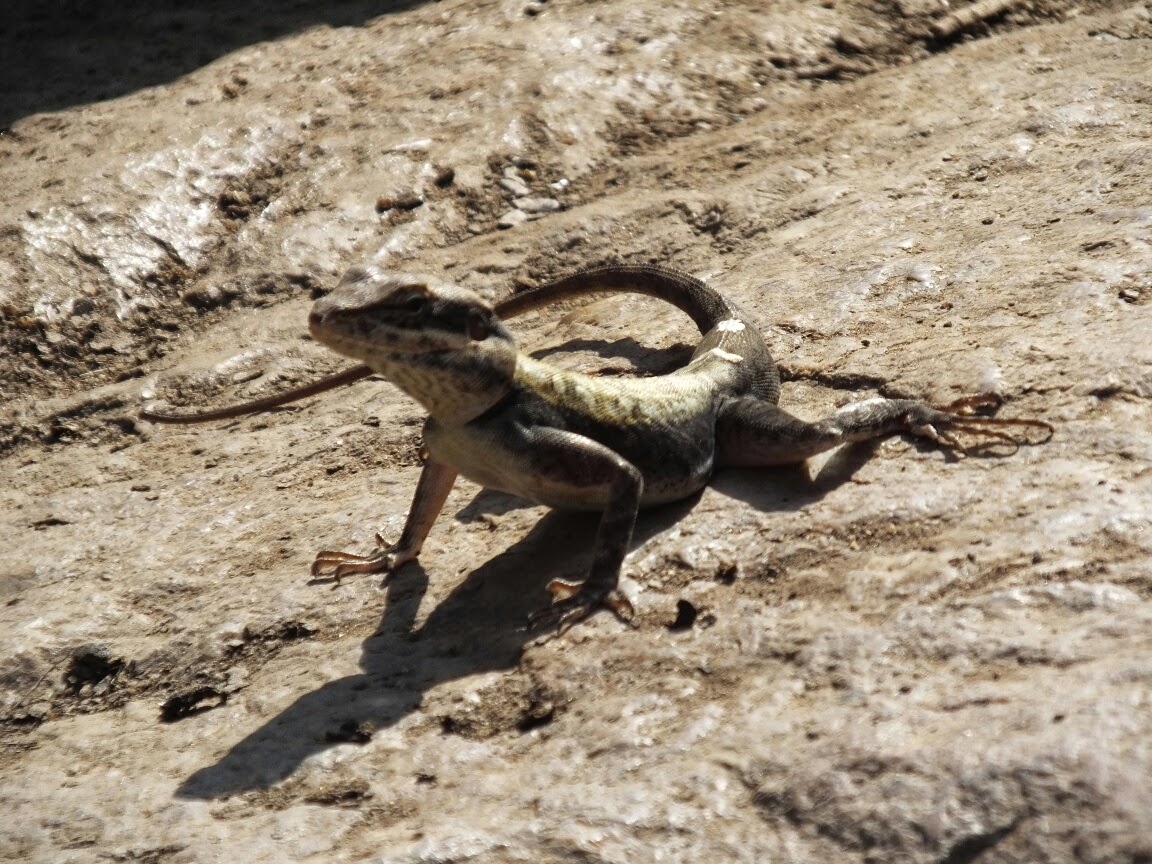
Apart from crows there is not a bird to be seen. Too much commotion on the near bank and on the far bank we can see a large pack of dogs running around making a row. We decide against taking the ferry across there. We head away from the crowd but still very few birds until a Purple Heron glides in and lands on a small beach. We do spot a sunbatkhing lizard, species unknown. It doesn't seem to be a great day for birding so we decide to head back into town to take a proper look around the large Virupaksha temple. En route we see people taking a short cut across the site where the excavations are taking place. We fully expect a shout or whistle but nobody turns a hair and we get a good look into the very deep hole that has been dug. The walls suggest that this is/was a very big tank. The walls look to be in very poor condition and restoration is going to be a mammoth task.

Virupaksha is a working temple so it is shoes off. Admission is very reasonable at Rs 2 per head although the camera charge is a bit steeper at 50. There are plenty of worshippers around as well as tourists. We shrug off a man who would like to give us a guided tour and admire the carvings and statues. The two types of monkey are both here and appear to coexist reasonably peacefully. There is a rattle as a gate is opened and there is Lakshmi, back from the river. She walks across the courtyard and then turns to face the shrine before doing a kind of puja dance. This complete she turns and walks to the far end of the yard where she has a stall. The 50 rupees was worth it after all.

It is getting hot again so we head for a shady cafe, one that we have not previously tried. R has Masala Black Tea and D has Lemon Tea and both are excellent. The place seems to be well run so we note it down for supper tonight. We seem to have run through the major attractions of Hampi and it is too hot to go aimlessly wandering so we take an hour out to chill under the fan in our room. All too soon it will be time to pack and pay our bill. Our train from Hospet is at 6.30 so we need to leave Hampi at 5.30. No clubbing for us tonight.

R has made a discovery today. She has always had difficulty identifying where the shade is but now realises that it is usually where the auto rickshaws are parked. For our evening meal we chose thalis which were huge and less than £2 each. We need feeding up for tomorrow.

Wednesday, 4 February 2015

Tuesday 3rd '- The Full Monumonty

R has booked a yoga class for 7 a.m. so we set the alarm and D goes in search of the sunrise. There are a surprising number of people about but the sky looks very hazy and D allows himself to be distracted by a tall corrugated iron shed, easily the tallest modern building in Hampi. Close inspection reveals that this houses a processional chariot, paraded at major festivals. The sun does actually appear as a ball of fire for a few minutes.

After the yoga is over we go to breakfast, getting in before the crowd and actually finding some useful wifi. As we are getting ready for our excursion there is a knock at our door. Asif is there with another young man who is introduced as Venky. A says that he had a wedding to go to and that V will be our driver today. How very Indian.  We are soon ready and head down to the street where V leads us around the corner to the auto. He seems to know his way around and we are soon parking up at the first complex of temples, which includes a very nice Ganesha statue. The interface between the huge boulders and the man made structures is very striking. 
After about an hour we move on to see a few of the lesser sites including an underground temple, where an astute lady relieves us of 50 rupees for taking us along a short subterranean obstacle course to see the temple's hidden treasures. She quite fancies herself as a photographer as well, borrowing D's camera to take a couple of shots.

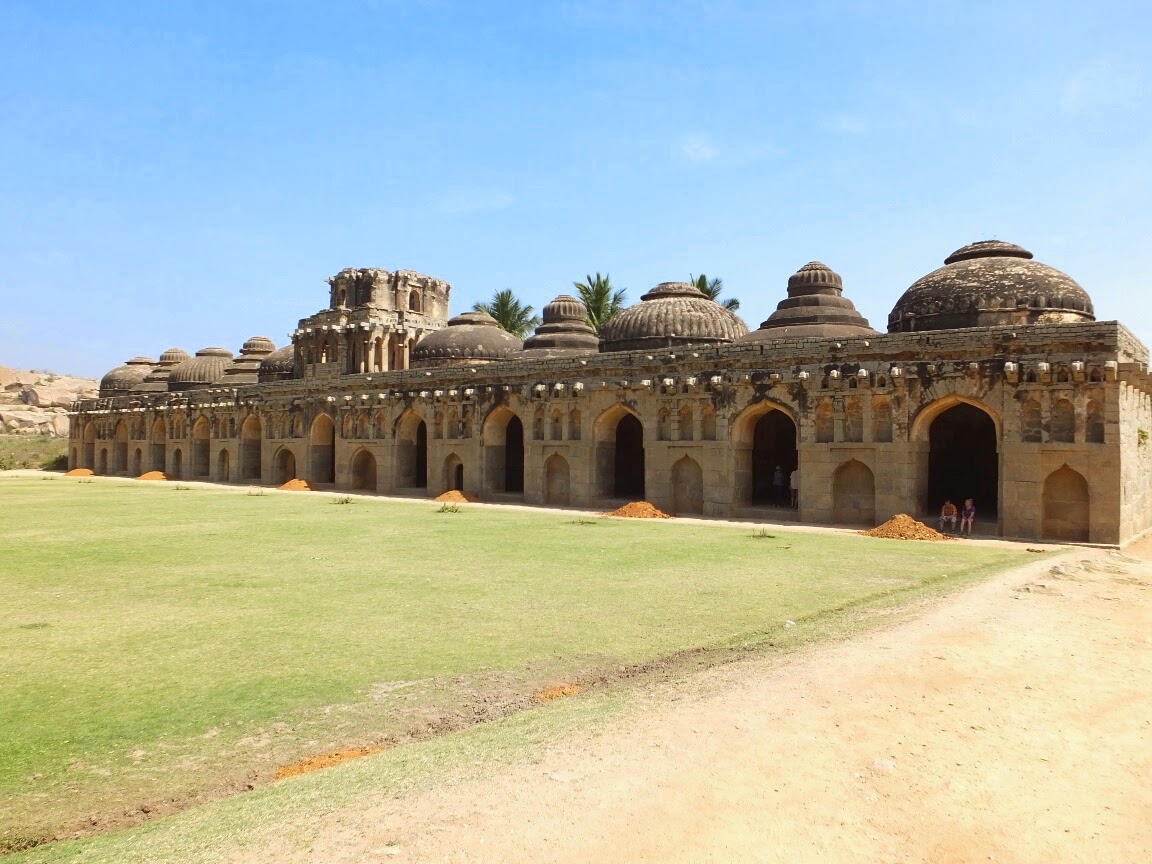
Next up is a large walled compound called the Zenana Enclosure.  Here we have to shell out for tickets so it had better be good. It is. The buildings are in better shape and there is some effort put into the upkeep. There is even a small museum of artefacts and photographs taken around the site as it was first recorded for the Indian Government.  R is particularly taken with the Elephant Stables. 

At the back of the Enclosure is a less well maintained area and a notice forbidding photography. Besides tourists busily taking photos the main occupants are a mixed flock of sheep and goats. Some of buildings in this area look to be in imminent danger of collapse but there is no evidence of conservation work in progress. 

By now it is almost one o'clock and really quite hot. Venki proposes a return to Hampi for lunch but we decide on the State Tourist hotel just outside the boundary of the former city and therefore allowed to sell beer. We pick up two more minor sites on the way including the Queen's Bathouse. The State hotel has a large covered terrace and we get a shady table. The beers are cold and not too expensive, and the pakoras are ok rather than brilliant but a rest and recharge is just the ticket. As we finish off with a black tea Venky appears, obviously keen to get on with things.

He takes us to the entrance to the Vittala Temple complex. Attempting to demonstrate his driving prowess he misjudges the braking distance and rams a parked auto. There is a crunch and we depart while a heated discussion takes place. From here one can take an electric buggy to the temple proper or walk about 2km. We walked and got chance to see some of the minor ruins along the way including a large tank, still full of water, and the remains of the bazaar stretching along either side of the track. There also birds to watch including several eye catching bee-eaters. Our tickets from earlier give access to this site where a couple of buildings are off limits due to restoration work.The highlight is the Stone Chariot but there is more to see including a crypt like underground chamber. 
Around the back of the main temple there are a number of other ruins but for R the big attraction is the flock of tiny Red Avadavats feeding in the long grass. We watch them for a while before deciding that we have seen enough sights and sites today. Seven hours in total. Back at the temple we find the queue for the electric buggies and eventually establish which end is the front and which the back. It's immaterial really as there is a mad dash from all parts of the queue and other places as well when the buggies arrive. We pay our fare and get on the fourth buggy to arrive and are soon reunited with Venky and the auto. On the drive back to Hampi he keeps peering out of the side of the auto to look at the front. After one speedbump he stops and gets out. D sees that the headlamp is now held on by a piece of string, presumably as a result of the bump.


Back at base D starts to pay and is told an amount 50% higher than agreed. Asif magically appears and says that the price is 60% higher than discussed. D stands his ground and hands over the 1000 rupees agreed. We were left with a rather unpleasant taste after a fascinating day. We are hot and dusty so showers are in order before lemon sodas at our rooftop wifi haunt. For supper we try the Mango Tree, now in a new location with a rather lurid lighting scheme.  We enjoy the musroom peas masalla with jeera rice but feel a little hustled by the brisk service. It is much cooler tonight as we walk a circuit of town before retiring.

Tuesday, 3 February 2015

Monday 2nd - Hello Hampi

We wake around 6 a.m. as our fellow traveller is starting to prepare for his stop. There is a coffee man on board but no chai seller so we decide to wait until we get off the train at Hospet. Nearly everybody on the train gets down at this stop, mostly bound for Hampi. There is quite a scrum on the platform as the auto drivers move in for the kill. R and the bags are parked on a nearby bench and D fetches chai from the stall. Very acceptable and only 5 rupees.

There is one young chap still on the platform and he asks if we want an auto. His quote is acceptable and he leads us out of the station to a well maintained machine. Driving out of the town we concur with LP's summary of 'a dusty, unattractive town with not much going on'.  What a shame that they didn't build Hampi closer to the railway.


On the way out of town we stop at the local Kwik Fit to get air in the auto's tyres. The hose is only long enough to reach two tyres so the third goes unfilled. We have travelled by Indian auto dozens of times and never given a thought to tyre pressures. Do we need to start kicking the tyres before we board?


Once out of Hospet the road surfaces are good for the 14km ride through fields of sugar cane and bananas. The scenery changes dramatically for the last couple of miles, becoming dominated by huge boulders and rocky outcrops. Some of the ruins for which Hampi is famous are clearly visible and as we clear the ridge above the town we see the towering presence of one of the great temples. 


Our chap drives through the narrow streets and deposits us at the Gopi Guest House. His name is Asif and he asks if we would be interested in a tour of the main sites and we take a card. We climb the stairs up to the Gopi and are greeted cheerfully, registered and are then invited to have breakfast. This is a leisurely affair and allows us to watch the comings and goings. After quite a while our room is ready. This is in an annexe round the corner and is basic, with fan rather than AC, but clean. R is feeling a bit woozy and decides that she needs to top up her sleep so D does a bit of local exploration. 

The village of Hampi Bazaar is quite small but somehow the layout is confusing. Cars are banned from the streets but there are still autos, motorbikes, pedal cycles and cows to contend with. This is the first place on this trip that we have found with a significant cow poo problem and you have to watch where you are stepping. The place is very much geared up for tourists and the majority of businesses are guest houses, retaurants, travel agents and internet cabins. The village used to be bigger but a couple of years ago part of it was declared an archaeological site and the inhabitants and businesses evicted at very short notice. A few businesses were able to relocate but it seems very hard on most of those affected. The site cleared is now being excavated using JCBs and dumper trucks.

Hampi itself is just one part of a huge city built by the Vijayanagara Empire from the 1300s. It grew to have a population of 500,000 but the empire was overthrown and the city destroyed.  Various temples and monuments survive spread over a wide area and these are the big attraction as they have World Heritage status. R is suitably refreshed and we set out to see some of the local sites, just up the hill above the village. As well as ruins there are birds to look at and down towards the river two different kinds of monkey - red faced ugly ones with quite long tails and rather more graceful ones with black faces and incredibly long tails. We search in vain for one of LP's recommended restaurants.  We later discover that it has been a victim of the archaeologists. 


We head back into town looking for a cold drink.  Alcohol is banned in Hampi so lemon sodas will have to do. We discover a place with half decent wifi and decide to return there for supper. We also decide to call Asif to book a tour for tomorrow. Finding a phone signal is a challenge but we eventually get one. After a short haggle a price is agreed along with a10 a.m. start. On the way to supper R drops her singed housedress off at the tailors for re-hemming.  "Will be ready tonight". We have momos, hummus amd falafels in an almost empty restaurant and catch up on emails etc. Back in the room we have to turn the fan up and wrestle with the mosquito net before turning in. We are getting soft.

Sunday 1st February - Yellow Cows

We go down for breakfast quite early and are surprised to find the restaurant near full. Maybe the Neil Sedaka tunes on the muzak system are a big draw. Today the buffet has an international feel offering baked beans, hash browns and ratatouille alongside the idlis and parathas. 


Out of our bedroom window we can see Chamundi Hill and its temple, which feature high on every auto driver's must see list. Our suspicion is that they are really fans of the 14km fare that a trip there will earn them. We have a short discussion of the merits of an outing and settle for a photograph through the bedroom window. The winning alternative is a lazy morning packing in the comfort of AC before we have to leave and take our kit to the Left Luggage at the railway station.


This is all achieved without drama and we set out unencumbered from the station to visit the Mysore Rail Museum. D manages to find the long route from the station but we don't get lost. The ticket office is in a guard's van situated just inside the entrance. This is a small museum but there are some interesting exhibits of narrow and metre gauge locos and rolling stock. Most of these are in better condition than the exterior exhibits we have seen in Delhi,  Kolkata or Chennai. You are free to climb aboard most of the exhibits so we take full advantage. 


We have read about a cafe in one of the hotels that is run by and for the benefit of women from disadvantaged groups and decide to take a look. It's another pleasant courtyard,  virtually deserted. We linger over coffees and lemon drizzle cake before taking a turn round the hotel garden. There is a restaurant under a canopy and at one end we find the aforementioned knitting bee. There is not much knitting going on right now but we chat to one lady.  They are a bit miffed about some of the things written in the newspaper. Certainly they don't look as ancient as described. They are preparing to entertain a large group of children from a home so we wish them luck and depart.

We walk back towards town as far as a place called the Pelican Pub where we stop for beer and nibbles. Our plan is to eat a meal later in the afternoon as we have an early evening train up to Hospet, an overnight trip of 543 km. The Pelican has an interesting policy, operating separate men's bars and mixed areas. It isn't very busy and we have a table on a shady terrace to enjoy our 70/- beers and onion pakoras. 

All good things must come to an end. Discussing food has made us hungry so we decide to head back to the Park Lane as we know they do food all day and there is free wifi. R does a good job of haggling with the auto driver and beats him down from 100 to 60. The Park Lane may not have been the smartest idea as we are compelled to watch England's ODI cricket team being pulverised by the Aussies. The food is OK but not a patch on last night.


With time to spare we walk back to the station. We had earlier noticed roaming cows with yellow patches rather than white. This evening we see an entire yellow cow and ponder the reason. R subscribes to the view that it is a side effect of eating banana skins while D thinks it is because they have been painted or sprayed. But why?


The station is all hustle and bustle. Our train is posted on the boards as platform 1 and then switched to platform 2. We recover our bags, cross the footbridge and find the coach with the First AC compartments. We have missed out on the 2 berth coupe this time but have a 4 berth to ourselves for the three hour tip to Bangaore which gives us plenty of time to make our beds up and sort ourselves out.. Night is falling as we leave Mysore and we amble across the darkened countryside,  stopping now and again at dimly lit stations. Predictably we sit outside Bangalore City Station for 20 minutes. 

When we pull into the platform it is bedlam with crowds of people running in both directions along the platform.  Our TTE stands in the coach door repelling boarders. A group of young Indians come into our cabin, challenging our right to be there. They are in the wrong coach and we send them packing. A Chinese man arrives and he does seem to be in the right place. We show him how the seat back folds down to make a bed and find out that he is getting off one step before us. The TTE arrives to check his ticket and seems surprised that the fourth berth is vacant. We switch the lights out and turn in for a good night's sleep.

Sunday, 1 February 2015

Saturday 31st - Toddling round town

 Breakfast is a leisurely affair to a soundtrack of Carpenters cover versions. Despite the entreaties of the auto wallas we decide not to take a grand guided tour of the city but to do our own thing. Asserting our independent traveller credentials we head for the Sapna bookshop across the city. The driver has no change. But D does. He is baffled when we turn down his offer to wait for us 'No charge'.

The bookshop occupies three floors and a vast range of subjects. D is looking for maps and finds plenty but not the one he is looking for. Next to the maps are the travel guides. LP's Great Britain for Indian Travellers catches the eye. Leafing through we discover some recommended authentic Indian restaurants in Edinburgh that we have never heard of.  It also contains the rather frightening information that an Indian Driving Licence is valid for 12 months in the UK. R finds a couple of yoga books and a small paperback that seems to suggest that she could learn Hindi in 4 weeks. If she starts today she will be able to practice when shopping in Delhi before we go home.

Today there is no cloud and it is going to be much hotter than yesterday. Keeping to the shady side of the street we walk back into town and spot yesterday's Modern Cafe just as we feel the need for a cuppa. This place must have been modern once upon a time. The tea is good though and sets us up for our assault on the State Emporium. We have been warned that there is only one genuine Karnataka State shop and dozens of imposters. We know straight away that we are in the right place as none of the staff even acknowledge our presence. These are civil sevants rather than thrusting entrepreneurs. We love it.
They have some fabulous furniture and carved elephants by the score. Some pieces of marquetry are very tempting but we would have to carry them for the next five weeks. R contents herself with a silk scarf and a couple of pairs of earings. As a state enterprise the full traditional retail system is used here. A sales person relieves you of your intended purchase and laboriously completes a form in a book, ensuring that two copies are made using carbon paper inserts. He issues you with the two copies for each purchase.


When you have finished shopping you take these flimsy documents to the cashier's desk. He relieves you of one copy plus oodles of bunce and returns the other copy to you having stamped it as paid. At the next counter you hand these copies over in exchange for your goods and the original top copy which is your receipt. Retail in the UK isn't half the fun it used to be.

We head in a generally easterly direction along a street of clothing shops. R is in the market for a full length house dress. She has such a garment in blue (see pictures from the beach house) but it is showing signs of wear and suffered a small but visible burn on the hem due to contact with a burning mosquito coil. There is a demanding specification to be met. It must be cotton, well made and above all, not look 'mumsy'. Manufacturers of such garments seem to think that mumsy is the very dab so the search is not easy. Most are rejected on all three grounds but one hanging outside a small shop catches the eye. After several minutes of unwrapping, displaying and discarding a suitable one is found. No haggling here. 'Fixed price' he says sternly, pointing to a sign. Business done he relaxes and asks if we have been to Rajasthan. He is from Jodhpur so we are able to tell him that we are fans of his home town and have been there twice.
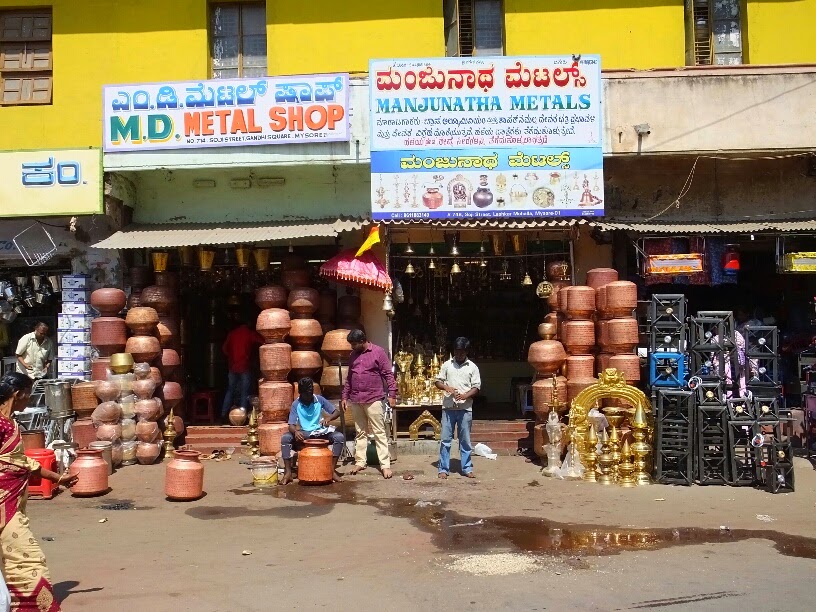
We move on into an area populated by hardware merchants, vendors of cooking pots and energetic metal bashers. Out of idle curiosity D asks the price of one of the copper pots about 2 feet in diameter and around eighteen inches deep. 3000 rupees. If we want one there is probably room to haggle. R tries a couple of tawas out for weight and quickly puts them down again. We watch a man hand making what appear to be stove tops on the pavement. 


All good things come to an end. We run out of shade and metalbashers and are accosted by a man who claims not to be a tout but who does want to advise us on where to shop. We shake him off and adjourn to the nearby Park Lane for a well earned refreshment. When we emerge it is roasting. We find an internet cafe with a fan and spend half an hour putting out blog pictures in the right places. This cannot be done on the tablet which is a bit of a bind. The auto ride back to the hotel is the shortest we have had in Mysore but he has quoted the highest price yet. When D asks if he is from Chennai he laughs.

After a rest and a shower we decide where to go for dinner. P recommended the Tiger Trail restaurant at one of the posh hotels so we opt for that. After a beer in the bar we are seated at a table in a large open air courtyard. The place is filling up, mainly with pink people who look as if they qualify for Senior discount on Indian Railways. Mysore does seem to have a lot of mature Western tourists - the Park Lane last night had few Indian customers. There was a piece on the front page of today's Times of India about a group of sixteen British ladies, aged 50 -70, who are in Mysore for a knitting holiday. That might explain some of it. 


 The menu is huge but we pin our choice down to Pudina Gosht, a lamb dish with fresh mint and Subz Dum Biryani which is a famous rice and vegetable dish cooked in a clay pot which has the lid sealed on with a ring of pastry to keep all of the cooking liquid in. They are both excellent as are the thin crispy rotis. So far so good as far as the food goes.

As we leave the smartly uniformed gateman offers to summon an auto. He does this with fierce blasts on a referee's whistle.  An auto appears and D asks for a price to our hotel. The man whispers a ludicrous amount for fear of being overheard by the gateman. D protests and the price drops. He tells us this is night charge. We have probably been ripped off but we will live with it.